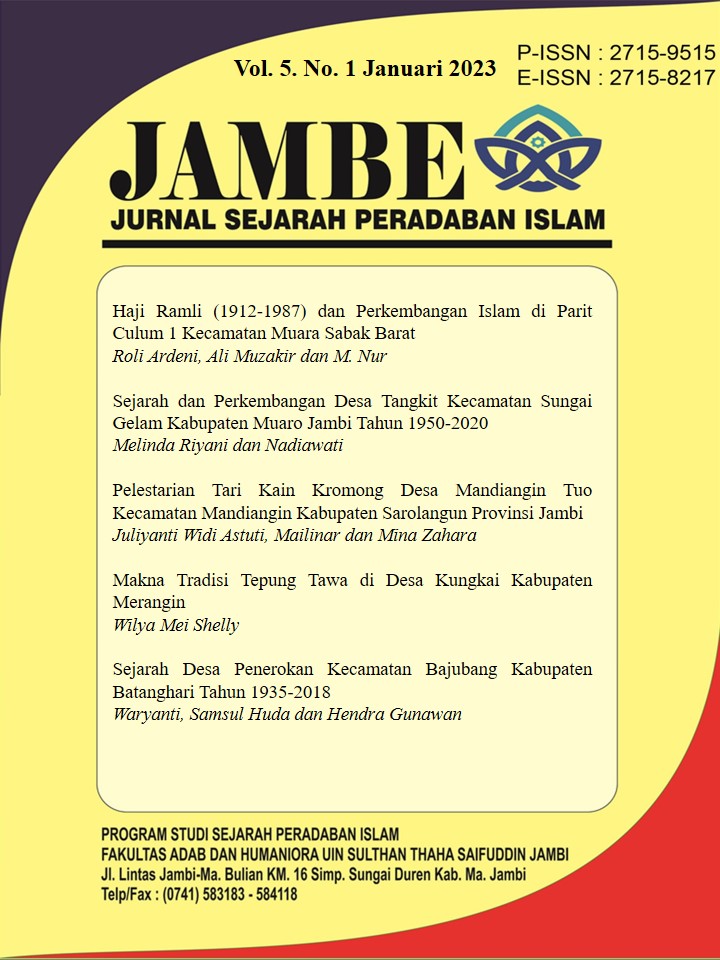
SEJARAH DESA PENEROKAN KECAMATAN BAJUBANG KABUPATEN BATANGHARI TAHUN 1935-2018
Abstract
Sejarah munculnya desa memiliki peranan penting pada pertumbuhan desa di masa mendarang. Penelitian ini membahas tentang Sejarah Desa Penerokan Kecamatan Bajubang Kabupaten Batanghari pada tahun 1935-2018. Tujuan penelitian ini yang pertama, untuk mengetahui bagaimana Sejarah Munculnya Desa Pencrokan pada tahun 1935-2018. Kedua, untuk memahami Sejarah Kepemimpinan Kepala Desa Penerokan.Ketiga, untuk melihat perkembangan kehidupan sosial masyarakat di Desa Penerokan Kecamatan Bajubang Kabupaten Batanghari. Penelitian ini menggunakan metode sejarah,metode ini memiliki empat tahap penelitian yaitu Heuristik (Pengumpulan Data),Verifikasi (Kritik Sumber), Interpretasi (Analisis Fakta Sejarah), dan Historiografi (Penuiisan Sejarah). Hasil penelitian ini menunjukkan bahwa Sejarah Desa Penerokan berdini pada tahun 1935. Menurut legenda masyarakat setempat dinamakan Dusun Terok karena wilayah tersebut memiliki sebush sungai yang cukup besar dan terdapat ikan yang banyak. Dusun Terok menjadi lokasi kedatangan bangsa kolonial Belanda bertujuan melakukan ekspedisi pengelolaan minyak di wilayah Kelurahan Bajubang. Kemudian mereka menjadikan wilayah Dusun Terok sebagai daerah singgahan atau transit untuk meletakkan barang-barang keperluan sehari-hari, selama melakukan aktivitas di Wilayah Bajubang. Hal ini yang menjadikan masyarakat setempat nenyebut wilayah Dusun Terok sebagai Kampung Penarukan. Kemudian seiring berjalannya waktu, dengan adanya UU No. 05 Tahun 1979 yarg mengatur tentang desa. Kampung Penarukan berubah menjadi Desa Penerokan pada masa kepemimpinan bapak Iyan Susanto
License and Copyright Agreement
In submitting the manuscript to the journal, the authors certify that:
- They are authorized by their co-authors to enter into these arrangements.
- The work described has not been formally published before, except in the form of an abstract or as part of a published lecture, review, thesis, or overlay journal.
- That it is not under consideration for publication elsewhere,
- That its publication has been approved by all the author(s) and by the responsible authorities—tacitly or explicitly—of the institutes where the work has been carried out.
- They secure the right to reproduce any material that has already been published or copyrighted elsewhere.
- They agree to the following license and copyright agreement.
Copyright
Authors who publish with Jambe : Jurnal Sejarah Peradaban Islam agrees to the following terms:
- Authors retain copyright and grant the journal right of first publication with the work simultaneously licensed under a Creative Commons Attribution License (CC BY-SA 4.0) that allows others to share the work with an acknowledgment of the work's authorship and initial publication in this journal.
- Authors are able to enter into separate, additional contractual arrangements for the non-exclusive distribution of the journal's published version of the work (e.g., post it to an institutional repository or publish it in a book), with an acknowledgment of its initial publication in this journal.
- Authors are permitted and encouraged to post their work online (e.g., in institutional repositories or on their website) prior to and during the submission process, as it can lead to productive exchanges, as well as earlier and greater citation of published work.
Licensing for Data Publication
Jambe : Jurnal Sejarah Peradaban Islam uses a variety of waivers and licenses that are specifically designed for and appropriate for the treatment of data:
- Open Data Commons Attribution License, http://www.opendatacommons.org/licenses/by/1.0/ (default)
- Creative Commons CC-Zero Waiver, http://creativecommons.org/publicdomain/zero/1.0/
- Open Data Commons Public Domain Dedication and Licence, http://www.opendatacommons.org/licenses/pddl/1-0/
Other data publishing licenses may be allowed as exceptions (subject to approval by the editor on a case-by-case basis) and should be justified with a written statement from the author, which will be published with the article.