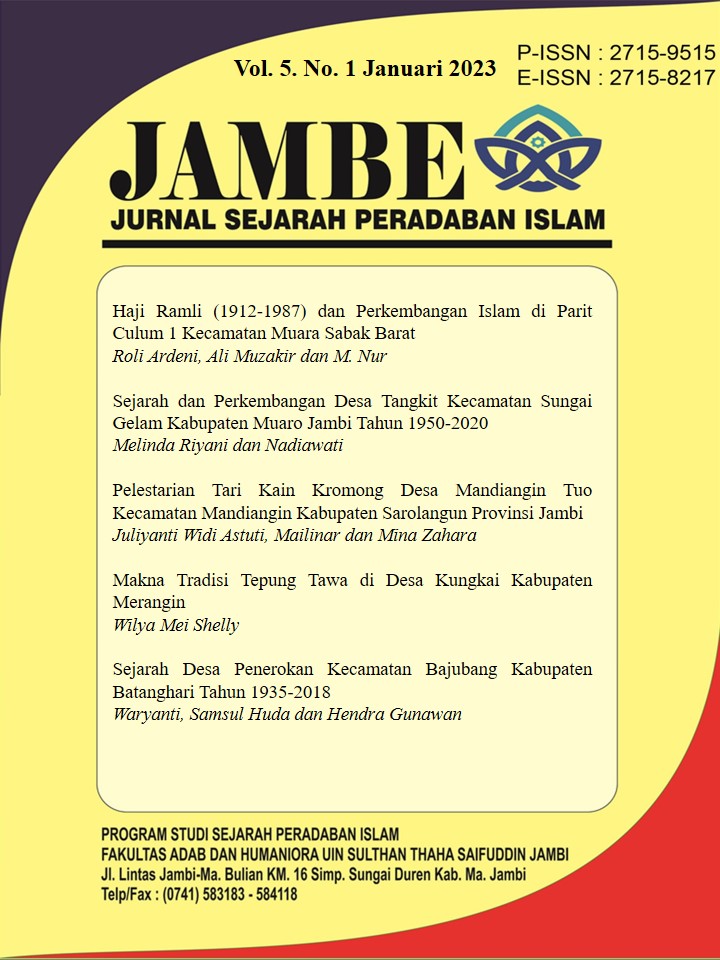
SEJARAH DAN PERKEMBANGAN DESA TANGKIT KECAMATAN SUNGAI GELAM KABUPATEN MUARO JAMBI TAHUN 1950-2020
Abstract
Penelitian mengenai sejarah desa merupakan hal yang penting untuk dilakukan mengingat bahwa hampir seluruh peristiwa sejarah berasal dari daerah pedesaan. Sejarah awal terbentuknya desa dimulai dengan adanya suatu kelompok masyarakat akibat sifat manusia sebagai makhluk sosial yang memiliki kepentingan yang sama. Namun masih ada sejarah desa yang belum terkenal luas oleh publik salah satunya sejarah desa Tangkit, sehingga perlu untuk ditelusuri dan dilestarikan melalui tulisan agar generasi selanjutnya dapat mengetahui tentang keadaan desa sebelumnya. Maka dari itu, tulisan ini mencoba untuk menganalisis tentang sejarah desa dengan mengambil topik Menguak Sejarah dan Perkembangan Desa Tangkit Kecamatan Sungai Gelam Kabupaten Muaro Jambi Tahun 1950-2020. Sebelum tahun 1950, desa Tangkit belum menjadi desa defenitif dan masih bergabung dengan wilayah Sungai Terap kecamatan Kumpeh. Lalu sekitar tahun 1957 terjadi pemekaran sehingga desa Tangkit menjadi wilayah otonom dengan kecamatannya Sungai Gelam. Istilah penamaan Tangkit berasal dari pangkalan perahu di jembatan sungai yang mana bentuk tanahnya berbukit. Tujuan dari penelitian ini untuk mendeskripsikan sejarah terbentuknya desa Tangkit dan menambah khazanah keilmuan dan pengetahuan mengenai sejarah desa. Dalam penulisan ini menggunakan metode penelitian sejarah yang terdiri dari empat tahapan yaitu heuristik, verifikasi, interpretasi dan historiografi. Pengumpulan sumber didasarkan pada studi lapangan atau wawancara. Kiranya hasil penelitian ini dapat bermanfaat dan bisa menjadi bahan referensi di kemudian hari bagi siapapun yang ingin meneliti tentang sejarah desa terutama bagi generasi muda agar memiliki ketertarikan untuk menulis sejarah daerahnya.
License and Copyright Agreement
In submitting the manuscript to the journal, the authors certify that:
- They are authorized by their co-authors to enter into these arrangements.
- The work described has not been formally published before, except in the form of an abstract or as part of a published lecture, review, thesis, or overlay journal.
- That it is not under consideration for publication elsewhere,
- That its publication has been approved by all the author(s) and by the responsible authorities—tacitly or explicitly—of the institutes where the work has been carried out.
- They secure the right to reproduce any material that has already been published or copyrighted elsewhere.
- They agree to the following license and copyright agreement.
Copyright
Authors who publish with Jambe : Jurnal Sejarah Peradaban Islam agrees to the following terms:
- Authors retain copyright and grant the journal right of first publication with the work simultaneously licensed under a Creative Commons Attribution License (CC BY-SA 4.0) that allows others to share the work with an acknowledgment of the work's authorship and initial publication in this journal.
- Authors are able to enter into separate, additional contractual arrangements for the non-exclusive distribution of the journal's published version of the work (e.g., post it to an institutional repository or publish it in a book), with an acknowledgment of its initial publication in this journal.
- Authors are permitted and encouraged to post their work online (e.g., in institutional repositories or on their website) prior to and during the submission process, as it can lead to productive exchanges, as well as earlier and greater citation of published work.
Licensing for Data Publication
Jambe : Jurnal Sejarah Peradaban Islam uses a variety of waivers and licenses that are specifically designed for and appropriate for the treatment of data:
- Open Data Commons Attribution License, http://www.opendatacommons.org/licenses/by/1.0/ (default)
- Creative Commons CC-Zero Waiver, http://creativecommons.org/publicdomain/zero/1.0/
- Open Data Commons Public Domain Dedication and Licence, http://www.opendatacommons.org/licenses/pddl/1-0/
Other data publishing licenses may be allowed as exceptions (subject to approval by the editor on a case-by-case basis) and should be justified with a written statement from the author, which will be published with the article.