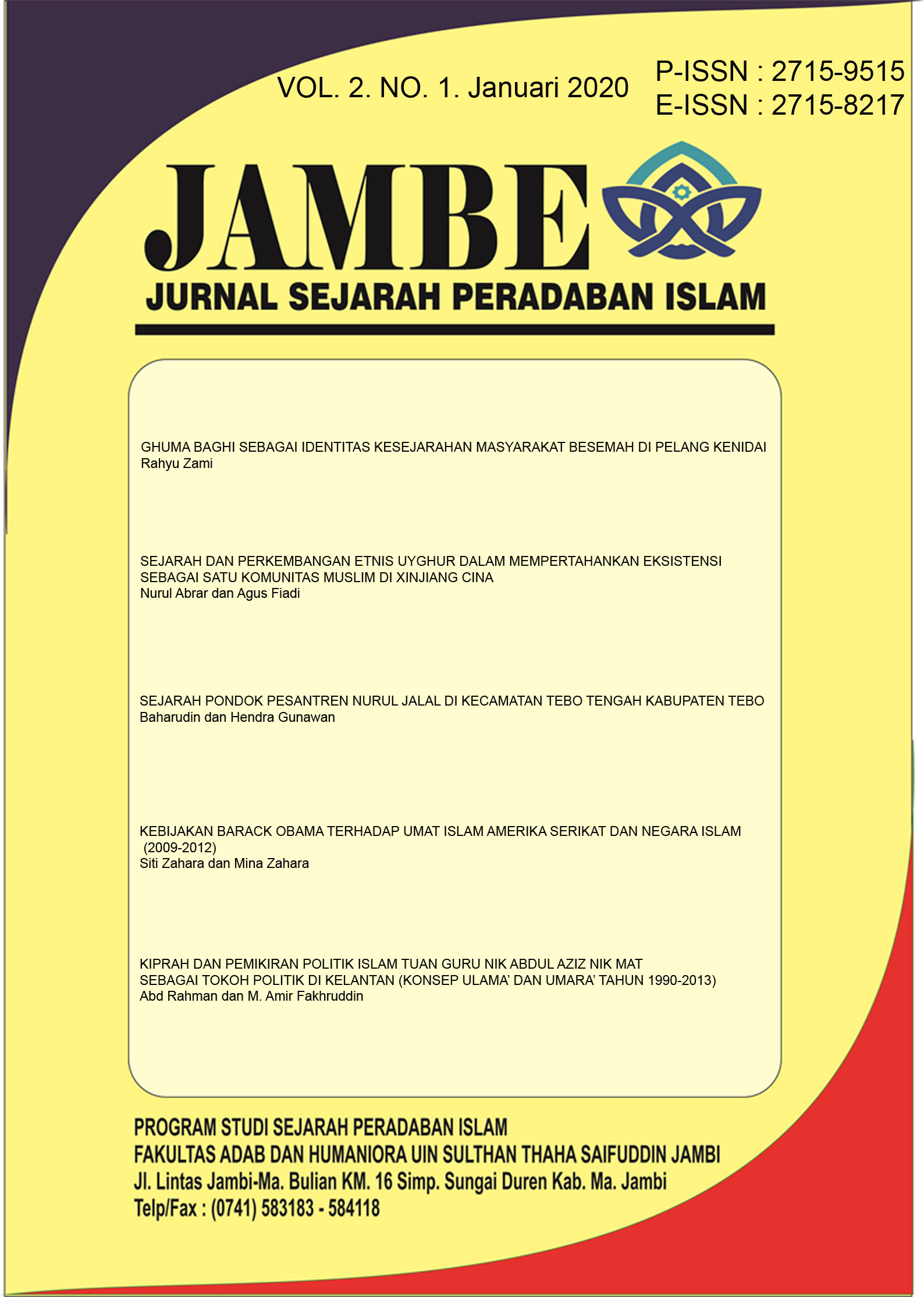
SEJARAH DAN PERKEMBANGAN ETNIS UYGHUR DALAM MEMPERTAHANKAN EKSISTENSI SEBAGAI SATU KOMUNITAS MUSLIM DI XINJIANG CINA
Abstract
Etnis Uyghur adalah penduduk asli Turkistan Timur yang berasal dari salah satu etnis Proto-Turki yang mendiami Asia Tengah. Uyghur merupakan wilayah terpenting dalam proses akulturasi budaya antara timur dan barat sebagai satu komunitas muslim tersendiri di Dunia. Namun, setelah Turkistan Timur secara resminya menjadi bagian dari wilayah Cina dan telah bertukar namanya menjadi Xinjiang pada tahun 1884, perkembangan etnis Uyghur terhambat oleh tindakan represif Cina yang akhirnya memicu lahirnya suatu konflik yang besar antara Uyghur, Pemerintah Cina dan etnis Han di Xinjiang. Dalam penelitian ini, penulis menekankan teori sejarah Ibn Khaldun untuk merekonstruksi sejarah etnis Uyghur sejak awal eksistensi mereka di Turkistan Timur. Penulis juga menggunakan teori siklus peradaban oleh Ibn Khaldun untuk menjabarkan perkembangan etnis Uyghur di Xinjiang serta teori Challenge and Response oleh Arnold J. Toynbee dan teori Dialektika oleh Hegel untuk menjelaskan konflik yang vital antara etnis Uyghur, dan pemerintah Cina di Xinjiang. Penelitian ini menggunakan metode sejarah, yaitu pengumpulan data (heuristik), kritik sumber (verifikasi), penafsiran (interpretasi) dan penulisan (historiografi). Berdasar pendekatan sejarah ini, penjelasan atas peristiwa-peristiwa masa lampau (historical explanation) didasarkan periode waktu selama munculnya eksistensi Etnis Uyghur dan proses perkembangan yang dilalui. Penelitian ini mengkaji Pertama, latar belakang Etnis Uyghur, kedua, sejarah Etnis Uyghur di Xinjiang, Cina dan ketiga, perkembangan Etnis Uyghur dalam mempertahankan eksistensi sebagai satu komunitas muslim di Xinjiang Cina.
License and Copyright Agreement
In submitting the manuscript to the journal, the authors certify that:
- They are authorized by their co-authors to enter into these arrangements.
- The work described has not been formally published before, except in the form of an abstract or as part of a published lecture, review, thesis, or overlay journal.
- That it is not under consideration for publication elsewhere,
- That its publication has been approved by all the author(s) and by the responsible authorities—tacitly or explicitly—of the institutes where the work has been carried out.
- They secure the right to reproduce any material that has already been published or copyrighted elsewhere.
- They agree to the following license and copyright agreement.
Copyright
Authors who publish with Jambe : Jurnal Sejarah Peradaban Islam agrees to the following terms:
- Authors retain copyright and grant the journal right of first publication with the work simultaneously licensed under a Creative Commons Attribution License (CC BY-SA 4.0) that allows others to share the work with an acknowledgment of the work's authorship and initial publication in this journal.
- Authors are able to enter into separate, additional contractual arrangements for the non-exclusive distribution of the journal's published version of the work (e.g., post it to an institutional repository or publish it in a book), with an acknowledgment of its initial publication in this journal.
- Authors are permitted and encouraged to post their work online (e.g., in institutional repositories or on their website) prior to and during the submission process, as it can lead to productive exchanges, as well as earlier and greater citation of published work.
Licensing for Data Publication
Jambe : Jurnal Sejarah Peradaban Islam uses a variety of waivers and licenses that are specifically designed for and appropriate for the treatment of data:
- Open Data Commons Attribution License, http://www.opendatacommons.org/licenses/by/1.0/ (default)
- Creative Commons CC-Zero Waiver, http://creativecommons.org/publicdomain/zero/1.0/
- Open Data Commons Public Domain Dedication and Licence, http://www.opendatacommons.org/licenses/pddl/1-0/
Other data publishing licenses may be allowed as exceptions (subject to approval by the editor on a case-by-case basis) and should be justified with a written statement from the author, which will be published with the article.